How to Choose the Best UV Curing Equipment in China?

Time:2026-09-18 Author:Sophia
0%

Choosing the right Uv Curing Equipment in China requires more than comparing prices. The equipment must match your materials, production speed, workspace, and quality targets. A lamp that cures adhesive quickly may still overheat plastic parts or create uneven results.

Begin with the curing process itself. Check the required wavelength, such as 365, 385, 395, or 405 nanometers. Measure irradiance at the work surface, not only at the lamp. Ask whether the system supports LED arrays, mercury lamps, conveyor integration, or custom fixtures. Cooling design also matters. Poor heat control can shorten LED life and damage sensitive components.

Supplier evaluation deserves equal attention. Review technical drawings, test reports, factory experience, and maintenance records. Request sample curing tests using your real adhesive, coating, or ink. Observe the cured surface, bonding strength, cycle time, and temperature rise. Reliable manufacturers should explain calibration methods, replacement parts, warranty coverage, and remote support clearly. Certifications are useful, but they should support actual performance rather than replace testing.

Small details matter.

A factory visit can reveal assembly quality, cable protection, and final inspection practices. However, no supplier is perfect. Some specifications may look impressive but remain difficult to verify. We should question unclear data and repeat tests under production conditions. A practical decision balances measurable performance, operating cost, safety controls, and long-term service. The best choice is not always the cheapest unit. It is the system that delivers stable curing every day, with evidence your team can trust.
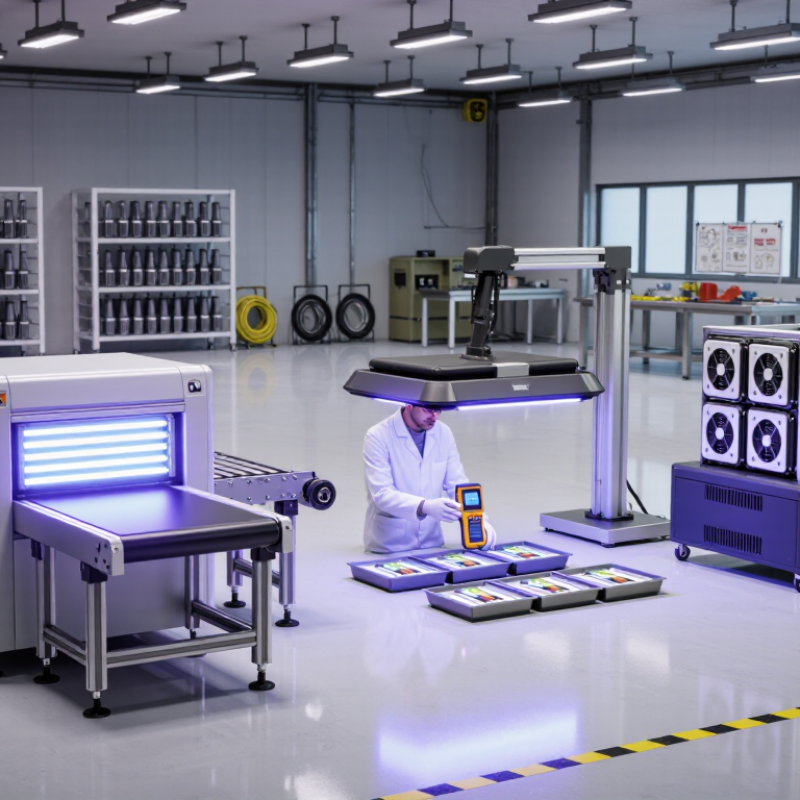
How to Choose the Best UV Curing Equipment in China?

UV Curing Equipment: Definition, Uses, and Core Technologies

UV curing equipment uses ultraviolet energy to harden inks, coatings, adhesives, and resins within seconds. It replaces long thermal drying cycles with controlled photochemical reactions. Common systems include mercury-arc lamps, UV LED modules, and hybrid designs. UV LEDs usually operate at 365, 385, 395, or 405 nanometres. The correct wavelength must match the photoinitiator, not merely the product label.

MarketsandMarkets reported that the UV curing market could grow from about USD 7.3 billion in 2023 to USD 10.6 billion by 2028. This growth reflects demand for faster production and lower energy use. When choosing equipment in China, inspect irradiance, dose stability, cooling, conveyor speed, and spare-part access. A factory trial matters more than a polished specification sheet. I have seen coatings remain tacky because the lamp looked powerful, but delivered insufficient dose at the work surface. That mistake is easy to repeat.

Tips: Measure irradiance with a calibrated radiometer. Test the actual substrate, coating thickness, and line speed. Ask for wavelength distribution and maintenance records. Compare energy consumption per cured piece, not only purchase price. UV LED systems can reduce heat exposure, but they may struggle with deep or heavily pigmented layers. Mercury lamps can provide broader output, yet require more ventilation and lamp management. The 2024 RadTech industry research also highlights continued investment in LED-compatible formulations, although conversion is not always simple. Leave room for doubt, and verify every claim under production conditions.

Key Factors for Choosing UV Curing Equipment in China

How to Choose the Best UV Curing Equipment in China?

Key Factors for Choosing UV Curing Equipment in China

China’s UV curing market serves printing, electronics, coatings, and adhesive applications. MarketsandMarkets projected the global UV curing system market to grow from about USD 2.1 billion in 2023 to USD 3.4 billion by 2028. This growth makes equipment selection more difficult, not easier. Start with the chemistry. Confirm the lamp or LED wavelength matches the photoinitiator, coating thickness, and substrate. A 395 nm LED may not cure every formulation effectively.

Measure process performance, not only rated power. Check irradiance, energy dose, conveyor speed, working distance, and temperature control. RadTech technical reports emphasize process consistency and energy efficiency as major advantages of UV and EB technologies. In practical testing, place a radiometer near the product surface, not beside the lamp. Small distance changes can affect curing results. Poor cooling can also shorten LED service life.

Safety and integration require equal attention. Ask for documented electrical protection, shielding, emergency stops, and compliance with relevant IEC and Chinese requirements. Evaluate ventilation, PLC communication, spare-part availability, and local technical support. Compare total operating cost over five years, including power, lamps, downtime, and maintenance. Industry forecasts are useful, but they are not guarantees. I would still request trial curing with real production materials. Laboratory samples can look perfect. Factory conditions often disagree.

How to Choose the Best UV Curing Equipment in China? - Key Factors for Choosing UV Curing Equipment in China

Selection Factor Recommended Technical Range or Requirement Why It Matters How to Verify Before Purchase Best-Fit Applications
UV Wavelength Select a wavelength that matches the photoinitiator: commonly 365 nm, 385 nm, 395 nm, or 405 nm. The wrong wavelength can cause incomplete curing, surface tack, poor adhesion, or excessive heat. Request a spectral output chart and compare it with the coating, ink, adhesive, or resin supplier’s curing recommendation. Adhesives, coatings, printing inks, electronics assembly, 3D printing, and optical components.
Irradiance Use the process requirement as the benchmark; laboratory and small-area systems may range from about 0.5 to 10 W/cm², while production systems vary widely by working distance and design. Higher irradiance can shorten cycle time, but excessive intensity may increase temperature or create uneven curing. Require irradiance measurements at the actual work surface, not only at the LED window or lamp face. Fast adhesive curing, high-speed printing, automated assembly, and continuous production lines.
UV Energy Dose Dose is calculated as irradiance × exposure time. Typical processes may require approximately 0.1–10 J/cm², depending on material and thickness. Dose determines whether the material reaches the required conversion, hardness, adhesion, and chemical resistance. Conduct tests at several exposure times and confirm surface cure, through-cure, adhesion, hardness, and final performance. UV adhesives, protective coatings, varnishes, encapsulants, and resin-based components.
Light Uniformity For precision processes, aim for at least 85–90% uniformity across the effective curing area, subject to the process tolerance. Uneven light distribution can produce inconsistent color, hardness, bonding strength, and dimensional stability. Ask for a mapped irradiance report covering the complete usable area at the specified working distance. Large panels, printed surfaces, displays, optical parts, and multi-point adhesive curing.
Working Distance and Curing Area Define the required curing field, fixture dimensions, and distance between the UV source and workpiece before selecting equipment. Irradiance generally decreases as distance increases, and an undersized curing area can reduce productivity. Confirm irradiance, uniformity, and cycle time at the actual fixture position and maximum product size. Benchtop workstations, robotic cells, conveyor systems, and customized production fixtures.
Cooling and Temperature Control Choose passive cooling for lower-duty applications and air or liquid cooling when high power, long duty cycles, or heat-sensitive parts are involved. Thermal control extends LED or lamp life and protects substrates, adhesives, electronics, and precision parts. Check workpiece temperature during the longest production cycle and review cooling alarms, airflow, filters, or chiller requirements. Plastic components, electronics, medical parts, optical assemblies, and heat-sensitive substrates.
UV Source Type UV LED systems offer instant start-up, adjustable output, and no mercury; mercury-vapor lamps provide broad-spectrum output but require warm-up and lamp replacement. Source type affects energy use, maintenance, wavelength flexibility, heat generation, and total operating cost. Compare measured output, warm-up time, replacement parts, expected service life, and process compatibility. LED: targeted curing and automated lines; lamp systems: broad-spectrum coatings, inks, and legacy processes.
Control and Automation Look for adjustable intensity, programmable exposure time, recipe storage, footswitch or PLC integration, and real-time status monitoring. Repeatable control reduces operator variation and supports stable production quality. Request an interface demonstration and confirm communication protocols, input/output signals, and data-recording functions. High-volume manufacturing, traceable production, robotic systems, and multi-step curing processes.
Safety Features Use shielding, interlocked doors or covers, emergency stops, warning indicators, and suitable UV protective measures. UV radiation can injure eyes and skin; effective enclosure and interlocks reduce exposure risk. Review the risk assessment, safety circuit design, leakage testing, operating instructions, and applicable local requirements. All industrial, laboratory, and production environments, especially open or semi-automated workstations.
Electrical Compatibility Confirm voltage, frequency, phase, rated power, plug type, grounding, and protection requirements for the installation site. Correct electrical matching prevents downtime, unstable output, and avoidable safety or installation problems. Request the equipment nameplate, electrical schematic, power consumption, and installation requirements. Workshops, factories, laboratories, and export-oriented production facilities.
Measurement and Calibration Use a calibrated UV radiometer or integrated monitoring system appropriate for the selected wavelength and intensity range. UV output can decline over time because of aging, contamination, temperature, or optical degradation. Ask for calibration records and define a periodic verification plan based on production risk and operating hours. Quality-critical bonding, medical products, electronics, optical parts, and regulated manufacturing.
Maintenance and Serviceability Prioritize accessible optics, replaceable filters or cooling components, clear maintenance intervals, and readily available spare parts. Simple maintenance reduces downtime and helps preserve consistent curing performance. Review the maintenance manual, spare-parts list, response process, warranty terms, and remote-support capability. Continuous production, facilities outside major service centers, and equipment used in multiple shifts.
Validation and Sample Testing Require sample curing using the actual material, substrate, thickness, geometry, and production speed. A laboratory result may not represent production performance because part geometry and line speed affect dose and uniformity. Evaluate cure depth, tack, adhesion, hardness, appearance, temperature, cycle time, and repeatability. Any application where curing quality, yield, or product reliability is critical.
Total Cost of Ownership Compare purchase price with energy consumption, cooling, consumables, calibration, lamp or LED replacement, labor, and downtime. The lowest initial price may result in higher operating costs or lower productivity over the equipment’s service life. Request a multi-year cost estimate based on operating hours, maintenance intervals, electricity rates, and expected output. Small businesses, contract manufacturers, high-volume factories, and facilities planning equipment upgrades.
Note: UV curing requirements vary by formulation, substrate, part geometry, distance, and production speed. Final equipment selection should be based on measured performance using the actual process materials and operating conditions.

How to Compare UV Curing Equipment Suppliers and Manufacturers

Choosing UV curing equipment in China requires comparing suppliers, not merely comparing prices. MarketsandMarkets’ 2023 analysis valued the global UV LED market at about USD 1.1 billion in 2023. It forecasts growth to approximately USD 2.8 billion by 2028. This expansion increases supplier choices, but also increases technical confusion.

Ask each manufacturer for measured irradiance, curing dose, wavelength tolerance, and uniformity data. A reliable supplier should test your actual coating, ink, or adhesive sample. Watch the conveyor speed, lamp distance, substrate temperature, and oxygen exposure. Request test records, calibration dates, and equipment serial traceability. Numbers matter.

Do not accept “high power” as a complete specification. Compare optical output at the working surface, not only electrical input. Check cooling design, LED replacement procedures, control-system compatibility, and spare-part availability. IEC 62471 documentation supports photobiological safety assessment, while ISO 9001 certification can indicate controlled production processes. It does not prove curing performance.

A factory audit can reveal more than a polished brochure. Look for optical measurement equipment, burn-in testing, and documented quality checks. Ask for references using similar materials and production speeds. Compare total cost over three years, including energy, maintenance, downtime, and technical support. My own caution is simple: a cheaper unit may be economical, but only if its dose remains stable. Many comparisons still overlook that point.

UV Curing Equipment Standards, Safety, and Quality Requirements

Choosing the best UV curing equipment in China requires more than comparing lamp power or purchase price. Standards, safety, and measurable curing quality should guide the decision. Ask the supplier for wavelength data, irradiance maps, curing-dose records, and equipment test reports. These documents reveal whether the system can produce stable results.

Reliable equipment should follow applicable Chinese GB/T requirements and relevant IEC safety principles. Confirm electrical protection, emergency stops, shielding, door interlocks, warning labels, and controlled UV leakage. Ventilation matters too. Some UV processes may generate heat or ozone, depending on the light source and materials. A properly designed exhaust system protects operators and improves process stability.

Quality also depends on measurement discipline. Use calibrated radiometers to check irradiance and dose across the working area. Inspect curing uniformity, conveyor speed, lamp aging, cooling performance, and replacement procedures. Ask whether calibration records are traceable and whether factory acceptance testing is available. In real production, even a strong lamp can fail when its output becomes uneven. I have seen teams trust nominal power too much. That is a mistake worth reconsidering. Request sample curing trials with your actual materials, thicknesses, colors, and production speeds. Keep the results, including failed tests, before approving the equipment. A dependable supplier should provide clear manuals, training, spare-part information, and responsive technical support.

How to Choose the Best UV Curing Equipment in China?

UV curing equipment is commonly selected according to spectral compatibility, irradiance, dose, uniformity, thermal control, shielding, and production-line safety. The chart below shows the internationally recognized ultraviolet wavelength bands relevant to equipment evaluation.

Selection guidance: Most LED UV curing processes operate in the UVA range, commonly around 365–405 nm. Confirm that the equipment spectrum matches the photoinitiator response of the coating, adhesive, or ink. For safety evaluation, review IEC 62471 and its Chinese equivalent GB/T 20145-2006, and verify shielding, interlocks, leakage control, exposure limits, calibrated irradiance measurement, dose repeatability, and temperature management.

Installation, Maintenance, and Cost Evaluation of UV Curing Systems

How to Choose the Best UV Curing Equipment in China?

Installation, Maintenance, and Cost Evaluation of UV Curing Systems

A reliable UV curing system starts with a site inspection. Check power capacity, ventilation, line speed, and available floor space. The curing chamber should match the coating width and production volume. Ask for measured irradiance, wavelength range, and curing dose data. Do not rely only on catalog values.

During installation, shielded enclosures, emergency stops, and interlocks require careful testing. Operators should verify lamp distance and conveyor speed with calibrated instruments. Small alignment errors can create tacky areas or uneven gloss. I have seen production teams adjust speed by eye. That approach often causes repeated defects.

Maintenance costs deserve equal attention. Clean reflectors and cooling filters regularly, then record irradiance readings. Replace lamps or LED modules when output falls below the process limit, not merely by age. Keep spare fans, sensors, and protective windows available. A cheaper quotation may hide difficult parts sourcing and long downtime. In one evaluation, energy use looked acceptable, but cleaning required excessive labor. That changed the real operating cost. Calculate purchase price, installation, electricity, consumables, maintenance, training, and lost production. Request a trial using your actual coating and substrate. The results may challenge your initial choice.

FAQS

How should I match UV curing equipment with my material?

Check the light wavelength against the photoinitiator and coating formula. A 395 nm LED may not cure every formulation. Test the actual substrate, thickness, color, and adhesive before purchase.

Which performance measurements matter beyond lamp power?

Measure irradiance, energy dose, conveyor speed, working distance, and temperature. Place a calibrated radiometer near the product surface. Nominal power can mislead.

Why is working distance important during curing?

Small distance changes can alter the received UV intensity. Keep the product position stable across the working area. A few millimeters may matter.

What safety features should the equipment include?

Request shielding, emergency stops, door interlocks, warning labels, and electrical protection. Check controlled UV leakage and documented safety testing. Do not rely on appearance alone.

Is ventilation necessary for every UV curing process?

Ventilation may be needed for heat or ozone, depending on the light source and materials. Ask for an exhaust assessment during production trials. Airflow affects stability.

How can I verify curing uniformity?

Use calibrated radiometers across the full working area. Record irradiance and dose at several positions. Check edges, center points, and moving samples. Uneven output can remain hidden.

What documents should I request from a supplier?

Ask for wavelength data, irradiance maps, dose records, test reports, manuals, and calibration records. Also request factory acceptance testing when available. Missing records deserve reflection.

How should I compare the long-term equipment cost?

Estimate five-year costs for electricity, lamps or LED modules, cooling, maintenance, spare parts, and downtime. A cheaper purchase may become expensive during repeated stoppages. The calculation is imperfect, but useful.

Conclusion

Choosing the right Uv Curing Equipment in China requires a clear understanding of how UV curing works, where it is used, and which core technologies best match your production needs. This guide explains the differences between UV LED and traditional UV systems, while highlighting important factors such as curing speed, wavelength, energy efficiency, working area, material compatibility, and system flexibility. It also outlines how to evaluate equipment suppliers and manufacturers by comparing technical capabilities, customization services, production experience, quality control, communication, and after-sales support.

In addition, the article reviews essential standards, safety measures, and quality requirements for reliable operation. It provides practical guidance on installation, ventilation, operator protection, routine maintenance, replacement planning, and troubleshooting. Finally, it introduces a complete cost evaluation method that considers purchase price, energy consumption, labor, maintenance, downtime, and expected service life, helping buyers select a safe, efficient, and cost-effective UV curing solution for long-term industrial use.

Sophia

Sophia

Sophia is a dedicated marketing professional with an exceptional depth of knowledge about her company's products and services. With a keen understanding of market trends and customer needs, she crafts insightful blog posts that not only inform but also engage readers, enriching the company’s online......