Top Fusion UV Curing Systems for Global Buyers

Time:2026-11-08 Author:Charlotte
0%

Choosing a Fusion Uv Curing System is not just a matter of comparing lamp prices. Global buyers need to match curing performance with their materials, production speed, and working environment. A coating that cures cleanly on a fast packaging line may behave differently on a heat-sensitive plastic part. Small details matter. These include wavelength, irradiance, exposure time, cooling, and the distance between the lamp and the product.

A useful evaluation starts with the actual production process. Ask suppliers for test results using your substrate, ink, adhesive, or coating, rather than relying only on general product claims. Check whether the system can integrate with existing controls and conveyors. Confirm what routine maintenance involves, how replacement parts are sourced, and what technical support is available in your region. These questions can reveal costs that a specification sheet may not show.

There is no universal best system. That is worth remembering. A higher output may improve line speed, but it can also affect heat-sensitive materials and energy use. Buyers should compare verified operating data, installation requirements, and service arrangements before making a decision. This guide reviews leading Fusion UV curing options through practical criteria, including application fit, control features, reliability, and supplier support. Some needs will remain specific to each factory, and a product comparison cannot replace a production trial. But it can help buyers ask sharper questions and avoid choosing equipment on headline specifications alone.
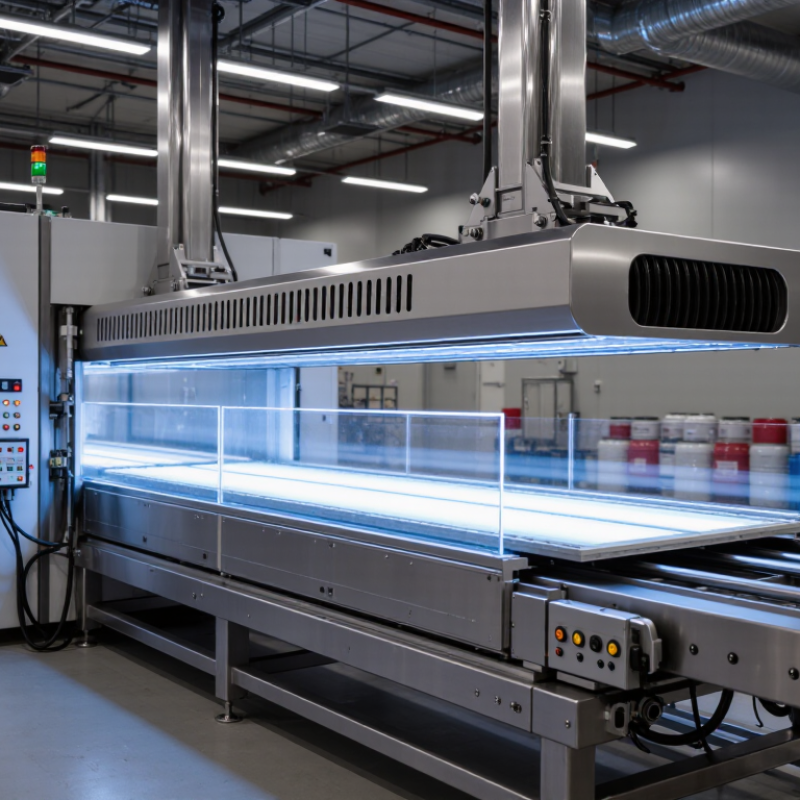
Top Fusion UV Curing Systems for Global Buyers

Define Fusion UV Curing: Irradiance (W/cm²) and Dose (mJ/cm²)

In a fusion UV curing system, irradiance and dose describe different parts of the exposure. Irradiance, measured in watts per square centimeter (W/cm²), is the UV power reaching a surface at a given moment. Think of it as intensity at the work plane. Dose, measured in millijoules per square centimeter (mJ/cm²), is the energy delivered over time. It is accumulated exposure, not a synonym for lamp strength. That distinction matters.

Under steady output, dose is approximately irradiance multiplied by exposure time, with unit conversion handled correctly. For example, a moving web receives less dose when conveyor speed rises, unless irradiance or exposure length changes. Real production lines are less tidy. Lamp aging, reflector condition, distance, spectrum, and material absorption can all shift results. A radiometer reading at one point may not represent the full web width or a curved component. Numbers can mislead.

When comparing systems, ask where irradiance was measured, which wavelength band was included, and how dose was verified. Match those conditions to the coating’s validated process window, then test actual parts. Surface tack, adhesion, and chemical resistance can reveal problems that one meter reading misses. There is no universal target. Even stable readings deserve periodic review, because setups and materials change. Treat both values as process controls, not buying claims.

Top Fusion UV Curing Systems for Global Buyers

Define Fusion UV Curing: Irradiance (W/cm²) and Dose (mJ/cm²)

This illustrative exposure profile shows irradiance reaching 1.2 W/cm² and a calculated total dose of 6,000 mJ/cm² over 9 seconds. Irradiance is the instantaneous UV power per unit area; dose is irradiance integrated over exposure time. The dose values use trapezoidal integration between samples. Actual curing results depend on the UV spectrum, substrate, and measurement setup.

Compare Mercury, Microwave, and LED Sources at 365, 385, 395, and 405 nm

Choosing a UV curing source means matching its output to the coating, ink, or adhesive—not just selecting a wavelength. Mercury lamps emit a broad spectrum with useful output near 365 nm. Microwave-powered systems commonly excite electrodeless mercury lamps, so they share broad-spectrum characteristics but differ in lamp design and operating behavior. Check the measured irradiance and dose at the work surface. The display value alone can mislead.

LED systems produce narrower bands, commonly centered at 365, 385, 395, or 405 nm. A 365 nm LED may suit formulations designed for shorter-wave output, while 395 and 405 nm can match initiators responsive to longer wavelengths. Neither is automatically better. Formulation chemistry, film thickness, pigments, and substrate all affect the result. Run a cure test.

Mercury systems can deliver broad output, but may add heat and require attention to lamp aging. Microwave-powered lamps avoid electrode wear, yet still need suitable ventilation and maintenance. LEDs offer targeted output and typically less radiant heat, though their performance depends on wavelength and optical alignment. Small details matter. Record irradiance, conveyor speed, and surface temperature during trials; I would not trust one successful pass as proof of a stable production window.

Top Fusion UV Curing Systems for Global Buyers - Compare Mercury, Microwave, and LED Sources at 365, 385, 395, and 405 nm

System Type Source and Spectral Output 365 nm 385 nm 395 nm 405 nm Startup and Control Thermal and Process Considerations Typical Fit
Mercury-arc UV system High-pressure mercury vapor lamp with broadband UV output and prominent emission lines, including around 365 nm and 404.7 nm. Output also includes shorter UV wavelengths and visible light; actual spectrum depends on lamp and reflector configuration. Strong compatibility. The mercury spectrum includes a strong 365 nm region; confirm that the coating’s photoinitiator and the system’s irradiance match. Broadband overlap. No principal mercury line at 385 nm; usable output depends on the lamp spectrum, optics, and formulation sensitivity. Broadband overlap. Not a narrow 395 nm source; verify measured output and cure response at the part. Strong line available. Mercury lamps include a prominent line near 404.7 nm, which can support compatible formulations. Typically requires warm-up and stabilizes before consistent production output. Intensity is commonly adjusted with lamp power, shutters, or conveyor speed, depending on system design. Radiant and convective heat can affect temperature-sensitive substrates. Some lamp configurations emit short-wave UV that can generate ozone; exhaust or ozone-control provisions may be required. Broadband-curing applications, established production lines, and formulations designed for mercury-lamp spectra.
Microwave-powered mercury UV system Microwave energy excites mercury vapor in a electrodeless lamp. Its UV spectrum is still mercury-based and broadband; microwave excitation does not make the output a narrow 365, 385, 395, or 405 nm band. Strong compatibility. Mercury emission includes the 365 nm region; validate spectral output at the working distance. Broadband overlap. Not a dedicated 385 nm peak; suitability depends on the formulation and system spectrum. Broadband overlap. Not a dedicated 395 nm peak; perform cure testing with the actual material and process settings. Strong line available. Mercury emission includes a prominent line near 404.7 nm. Often reaches operating output quickly and can be switched or controlled without the same electrode-related lamp limitations as conventional arc systems. Exact behavior varies by equipment. Can deliver substantial UV output, so substrate heating and cooling requirements still need evaluation. Ozone generation depends on lamp envelope, spectrum, and exhaust setup. High-throughput processes that benefit from mercury-spectrum broadband output and frequent cycling or production-line integration.
UV LED system Semiconductor emitters produce a relatively narrow band centered on a selected nominal peak, commonly available in 365, 385, 395, or 405 nm versions. Actual peak and bandwidth vary by emitter and system. Available as a nominal 365 nm LED. Check the measured peak, bandwidth, irradiance, and coating absorption. Available as a nominal 385 nm LED. A dedicated wavelength option can concentrate output near the target band. Available as a nominal 395 nm LED. Confirm that the photoinitiator absorbs effectively at the chosen wavelength. Available as a nominal 405 nm LED. Often selected for formulations designed to cure with near-UV/violet output. Typically provides near-instant on/off operation and electronic control. No lamp warm-up is generally required, though the system still needs thermal management. Usually produces less unwanted infrared radiation than broadband mercury sources, but the workpiece can still heat from absorbed UV and process conditions. LED output and lifetime depend on junction temperature and cooling. Wavelength-specific curing, localized exposure, heat-sensitive processes, and applications that benefit from frequent switching or reduced unwanted spectral output.

Selection note: Wavelength compatibility alone does not guarantee cure. Compare the material’s absorption and photoinitiator response with measured spectral irradiance at the work surface, and validate dose, line speed, working distance, and substrate temperature in the intended process.

Rank Fusion UV Systems by Power, Width, Cooling, and Production Speed

For global production, rank fusion UV systems by usable curing capacity, not headline wattage alone. High-power units can support faster line speeds, but only when the lamp spectrum matches the ink or coating and the dose reaches the full surface. Ask for measured irradiance and energy data at the intended working distance. Numbers without test conditions are hard to compare.

Width comes next. A system should cover the widest product consistently, including edges, where uneven exposure can leave tacky spots. For narrow labels, a compact unit may be more efficient than a wide chamber. For boards or panels, coverage matters more than a small difference in peak power. Cooling also deserves a high rank: stable airflow or water cooling helps control heat during long shifts. Watch the substrate temperature, not just the display.

Production speed is the final test, and the ranking can change on the factory floor. Compare curing results at the actual conveyor speed, lamp distance, and material load. Run a sample batch. Then inspect adhesion and surface finish after cooling. I would not trust a speed claim tested on an empty belt. That is an easy mistake. A balanced system with moderate power, adequate width, and dependable cooling may outperform a stronger unit that overheats or cures unevenly. The awkward part: operators may still need to adjust settings between materials.

Validate Cure Quality with Dose Uniformity and Substrate-Specific Tests

Fusion UV curing systems should be evaluated by measured cure quality, not lamp specifications alone. Start with dose uniformity across the full working width. Use a calibrated radiometer suited to the system’s spectral output, and record readings at the center and near both edges. Keep conveyor speed, lamp settings, and measurement position consistent. Small gaps matter.

A strong center reading can hide weak exposure at the edges. Map dose at several points and repeat the test after warm-up. Then cure representative samples under the same conditions used in production. Check surface tack, adhesion, and hardness with suitable methods, rather than relying on appearance alone. A clear finish is not always a fully cured finish.

Substrates respond differently to UV exposure. Test each actual material, including its color, thickness, and surface treatment. For heat-sensitive plastics, monitor temperature as well as cure performance. For coated panels, inspect both the exposed surface and adhesion after curing. Keep sample records and note any changes in speed or lamp output. Test results can be imperfect; that is a reason to investigate the process, not to average away inconvenient readings.

Check Global Readiness: Voltage, Safety, Compliance, and Service Coverage

Top Fusion UV Curing Systems for Global Buyers

Check Global Readiness: Voltage, Safety, Compliance, and Service Coverage

A curing system that runs well in one factory may not suit another site. Confirm the plant’s voltage, phase, frequency, and allowable fluctuations before comparing equipment. Ask for the electrical nameplate and installation requirements; a 50 Hz supply or different three-phase connection can affect commissioning. Check that the machine’s electrical design aligns with applicable requirements, such as IEC 60204-1, and request documentation for local conformity assessment. Details matter.

UV exposure needs equal attention. NIOSH’s Criteria for a Recommended Standard: Occupational Exposure to Ultraviolet Radiation recommends limiting effective exposure to 3 mJ/cm² over an eight-hour workday. This is a useful occupational reference, not a substitute for local rules or a site-specific risk assessment. Ask about shielding, interlocks, leakage measurements, and the photobiological safety information relevant to the light source. A checklist can still miss a poorly positioned guard, so verify the installed system.

FAQS

What is the difference between irradiance and dose in UV curing?

Irradiance is UV power reaching a surface at a moment, measured in W/cm². Dose is accumulated energy, measured in mJ/cm². They are related, but not interchangeable.

How does conveyor speed affect UV dose?

A faster conveyor usually gives each part less exposure time and a lower dose. Under steady output, dose is approximately irradiance multiplied by exposure time. Check the units and test the actual line.

Why might one meter reading fail to describe the whole curing process?

Readings can vary across a wide web or curved part. Lamp age, reflector condition, distance, spectrum, and material absorption also matter. One number can mislead.

How do mercury, microwave-powered, and LED sources differ?

Mercury sources produce broad-spectrum output. Microwave-powered systems commonly use electrodeless mercury lamps, with similar broad-spectrum characteristics. LEDs produce narrower bands and typically less radiant heat. Details matter.

How should I choose between 365, 385, 395, and 405 nm LEDs?

Match the wavelength to the coating, ink, or adhesive formulation. Initiators respond differently, and pigments, film thickness, and substrates affect curing. Run a test on actual parts.

What should I check when choosing a system for different product widths?

Confirm consistent exposure across the full product, including its edges. Narrow products may suit compact systems; boards and panels need reliable full-width coverage. Inspect for tacky spots.

Why is cooling important during long production runs?

Stable airflow or water cooling can help control heat. Monitor the substrate temperature, not only the system display. Heat can change during a shift.

How can I verify that a system will cure parts at production speed?

Test at the intended conveyor speed, lamp distance, and material load. Inspect adhesion and surface finish after cooling. One successful pass is not proof of stability. I might overlook that, too.

Conclusion

Choosing a Fusion Uv Curing System starts with understanding the difference between irradiance, measured in W/cm², and dose, measured in mJ/cm². Buyers should compare mercury, microwave, and LED light sources at wavelengths such as 365, 385, 395, and 405 nm, matching the output to the ink, coating, adhesive, or other material being cured. System selection also depends on practical production needs, including power, curing width, cooling method, and line speed.

A reliable setup should be evaluated through dose uniformity checks and tests on the actual substrate, since surface condition and material type can affect cure quality. Before purchasing, confirm that the equipment suits the facility’s voltage and safety requirements, and review relevant compliance documentation, installation support, and service coverage. Together, these checks help buyers assess whether a system can deliver consistent results and fit their production environment.

Charlotte

Charlotte

Charlotte is a seasoned marketing professional with a deep understanding of the company's portfolio and a passion for elevating its presence in the market. With a keen eye for detail and a commitment to excellence, she ensures that our professional blog is regularly updated with insightful articles......