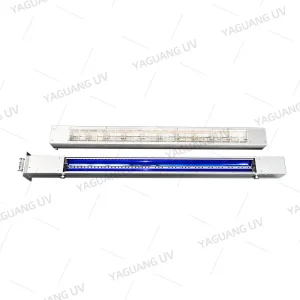
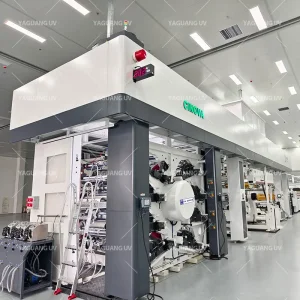
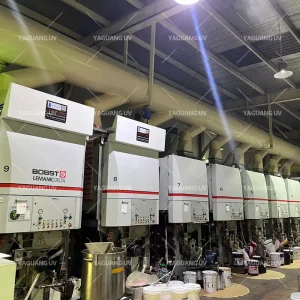
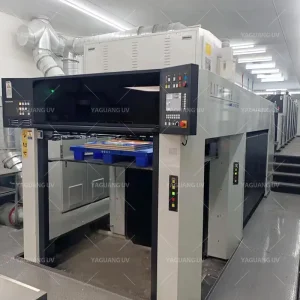
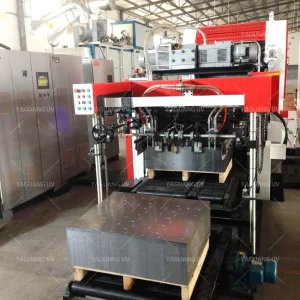
Explore our flagship industrial drying & curing systems, designed to retrofit seamlessly into leading global press models.
Established in 2006 and headquartered in Dongguan, China’s preeminent manufacturing hub, Dongguan Yaguang Machinery Co., Ltd. has spent nearly two decades defining the state-of-the-art in industrial UV and LED-UV curing technology. As a recognized National High-tech Enterprise, we integrate advanced research & development, state-of-the-art precision production, global sales channels, and dedicated support services.
Our core mission revolves around providing turnkey custom digital printing solutions and heavy-duty curing integrations designed to execute high-speed substrate curing under absolute reliability parameters. From heavy metal printing installations to packaging flexo systems, Yaguang systems consistently enhance throughput, reduce operational carbon footprints, and satisfy stringent global safety standards.
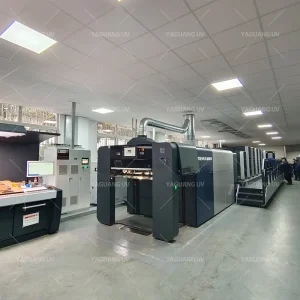
Fully compatible with Heidelberg, KBA, Komori, Roland, and sheet-fed metal printers.
Over 2,000 active industrial systems installed, commissioned, and supported worldwide.
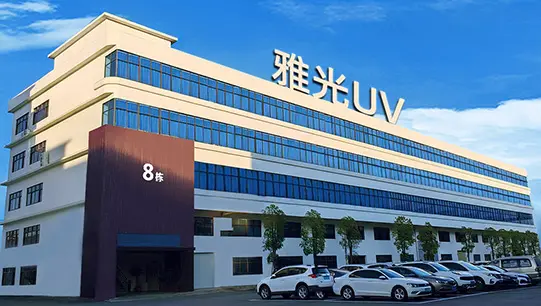
Our engineering excellence, proprietary patents, and extensive market deployment form the foundation of our industrial leadership.
Yaguang’s senior engineering team comprises industry-leading specialists with over 10 years of experience in UV system design, optical alignment, micro-coolant integration, and troubleshooting. We specialize in adjusting mechanical parameters to match any high-speed industrial printing machine.
Decades of continuous capital injection into R&D have allowed us to lock down multiple core patents in high-intensity cooling mechanisms and energy regulation. Every UV-LED system we export is fully certified with CE compliance, ensuring absolute security, durability, and reliability.
Our systems run inline with elite European and Asian machinery manufacturers including Heidelberg, KBA, Roland, Komori, Mitsubishi, and Ryobi. For metal packaging, we supply custom integrations for Fuji, Queley, and Ruiyuan lines.
Tracking the shift from conventional thermal and mercury arc drying to advanced solid-state LED-UV multi-band curing ecosystems.
Conventional medium-pressure mercury systems operate with broad-spectrum outputs that generate high thermal strains on thin substrates and emit heavy ozone concentrations. Yaguang’s technology roadmap integrates narrow-band semiconductor arrays emitting high-intensity UV light at 365nm, 385nm, 395nm, and 405nm. By combining multiple wavelengths, we ensure surface curing and deep-layer penetration occur simultaneously, eliminating the need for high thermal energy, reducing consumption by up to 70%, and achieving complete photoinitiator polymerization.
The limiting factor in high-power LED-UV output is heat dissipation. Excess thermal energy on the diode junction degrades wavelength stability and reduces lifetime. Yaguang introduces proprietary water-cooled architectures using CNC-machined copper micro-channels directly bonded to aluminum nitride (AlN) ceramic substrates. This delivers a thermal conductivity rate of >180 W/mK, keeping junction temperatures below 60°C and ensuring a stable irradiance profile of up to 24 W/cm² even at speeds exceeding 15,000 sheets per hour.
Our future-proof control panels incorporate Modbus, CANopen, and Ethernet/IP protocols to interface directly with the main printing press console. Through real-time current monitoring, infrared optical sensors dynamically scale LED output based on sheet presence and printing speeds. The integration of IoT predictive maintenance allows production plants to track chip lifetime, coolant flow rates, and spectral degradation, avoiding unplanned downtime.
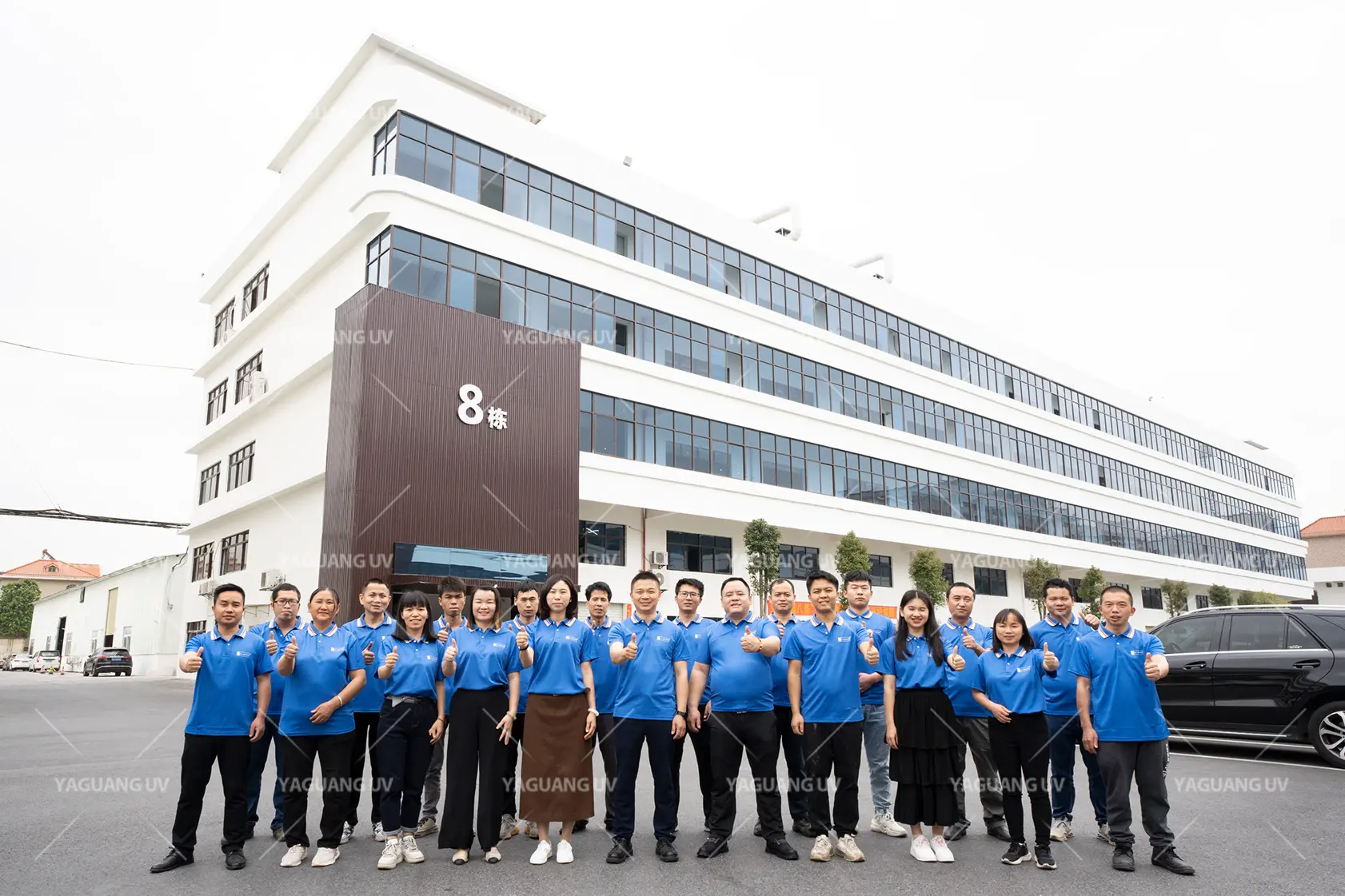
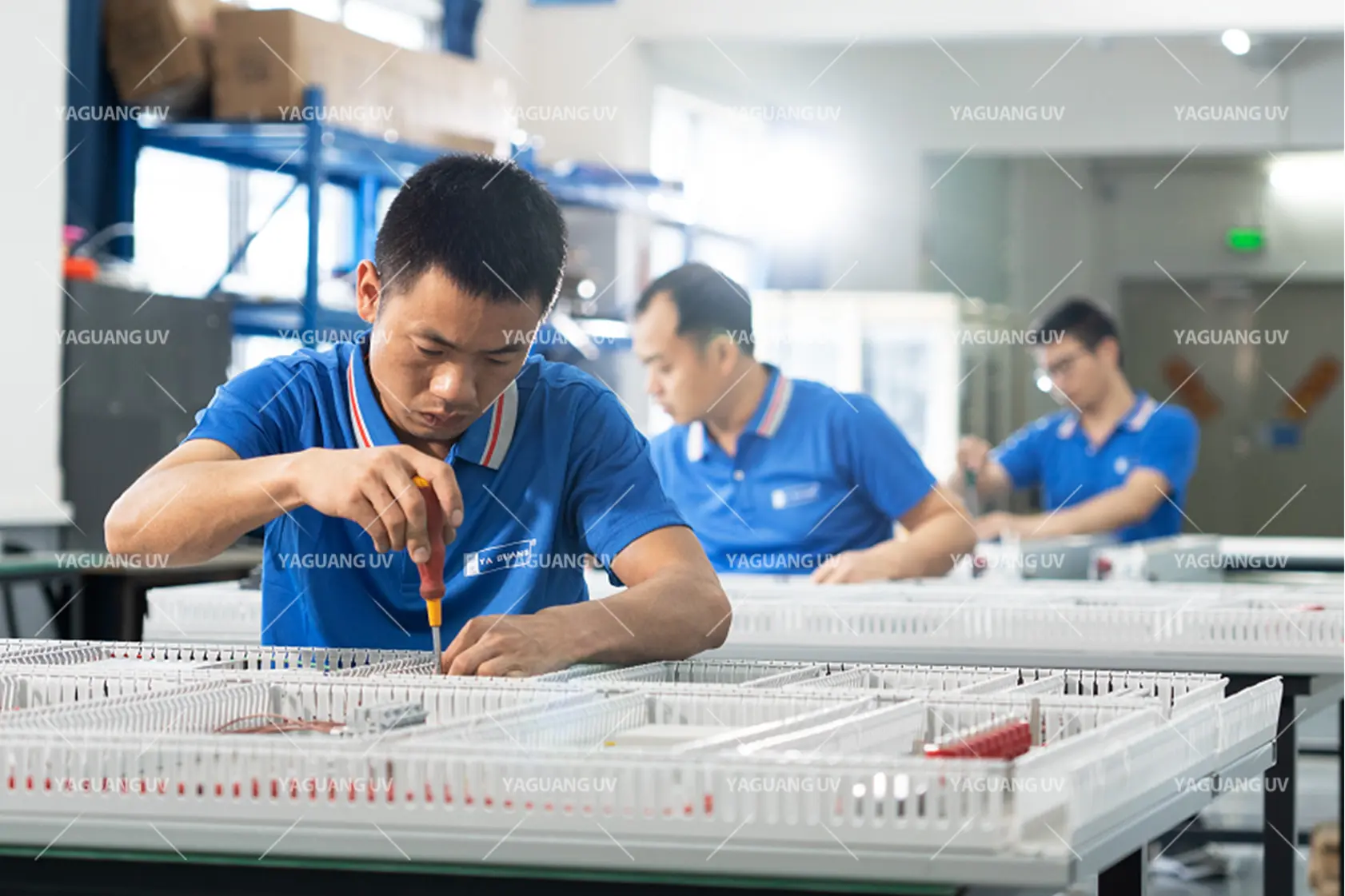
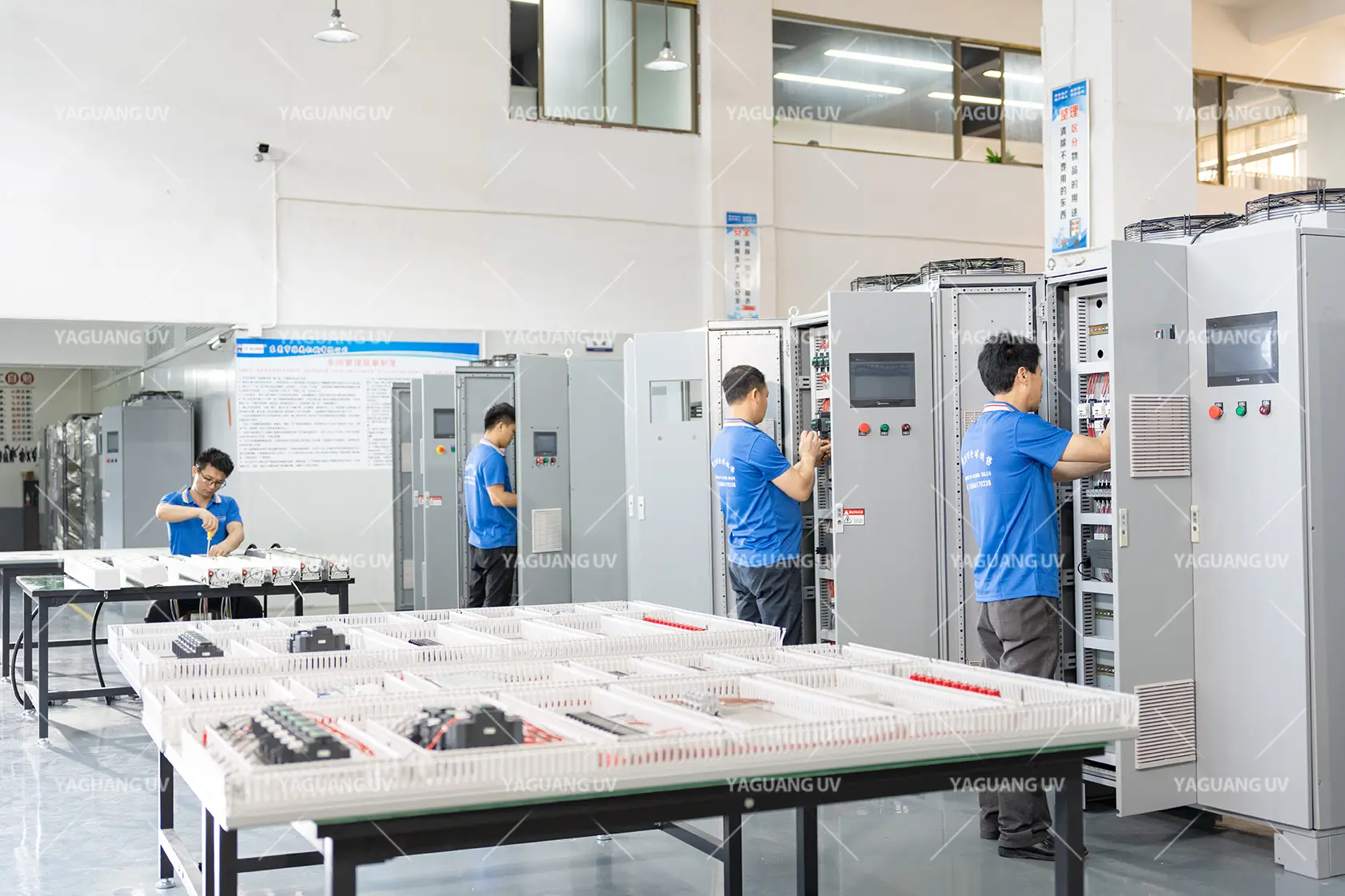
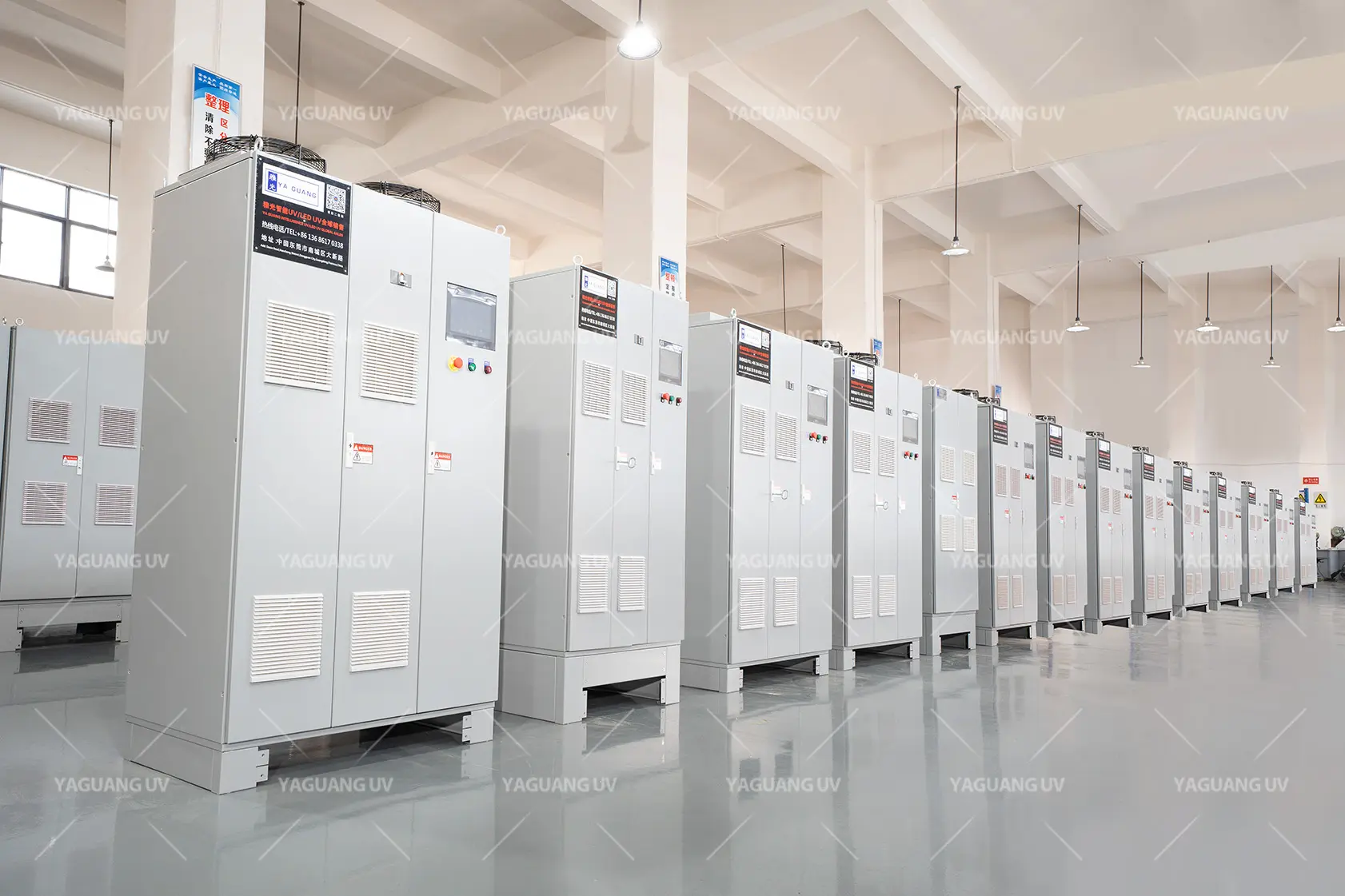
Our factory in Dongguan acts as the logistical heart of our global supply network. By employing a vertical integration strategy, we control the entire lifecycle of our curing systems—from the initial mechanical layout modeling and CNC machining of lamp housings to the automated surface-mount technology (SMT) packaging of high-intensity LED chips.
This complete end-to-end oversight insulates international buyers from volatile supply chain shifts. By sourcing premium sub-components locally and maintaining deep strategic inventory stockpiles, Yaguang guarantees stable lead times, robust product performance, and an average production-to-shipment timeline that is 30% faster than western competitors.
Proven stats backing our status as a premium global supplier.
Tailored curing solutions engineered to optimize specific printing formats, speeds, and media surfaces.
High-speed publication and packaging presses demand instant ink drying to prevent smearing during double-sided perfecting. Our water-cooled and air-cooled curing modules integrate within the delivery frame of Heidelberg Speedmaster or Komori Lithrone presses, matching speeds up to 18,000 sheets per hour without compromising paper register.
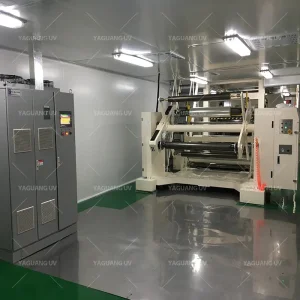
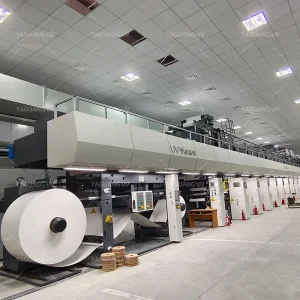
Flexographic lines handling heat-sensitive substrates (like PET, BOPP, and PE films) require extremely low thermal transfer. Yaguang LED-UV assemblies use advanced cold UV curing techniques. By emitting light concentrated within the narrow UV-A spectrum, thermal expansion is eliminated, preventing substrate warping.
Industrial metal sheet-fed printing (such as three-piece cans and aerosol canisters) requires robust thermal resilience. Our heavy-duty UV systems provide the sustained optical power needed to cure thick protective coatings and metallic inks on tinplate and aluminum, integrating smoothly with Fuji and Queley systems.
Procuring industrial curing machinery requires compliance with localized environmental and electrical regulations. International buyers face strict ESG mandates to eliminate hazardous materials. Yaguang’s systems meet these requirements directly.
Our mercury-free LED systems emit zero ozone, helping facilities comply with VOC reduction policies and clean air standards. To ensure safe integration into local electrical grids, all major assemblies carry official CE certification.
To support these installations, our service hubs in Shanghai, Tianjin, and Zhejiang work alongside overseas engineering partners to deliver rapid replacement components, remote diagnostics, and on-site alignment services.
Find detailed answers to common questions about industrial retrofits, energy efficiency, and LED-UV integrations.
Converting a conventional mercury UV system to a Yaguang LED-UV system typically reduces overall electrical demand by 60% to 75%. Mercury systems require constant standby power to maintain arc temperatures, whereas LED-UV chips turn on and off instantly, drawing power only during active sheet transport. Additionally, the lower heat load reduces the energy required by the press's internal cooling units.
Yes. Our systems are engineered to integrate directly with the mechanical chassis and electronic control networks of major press brands, including Heidelberg Speedmaster, KBA Rapida, Komori Lithrone, and Roland. We provide custom-machined mounting brackets, interlocked safety guards, and control integration via standard fieldbus interfaces.
Our water-cooled systems require minimal regular maintenance. Key tasks include checking the chiller's deionized water level, replacing the water filter cartridge every 6 to 12 months to prevent mineral scale buildup, and cleaning the protective quartz lens window with isopropyl alcohol to maintain optical transmittance. The LED diodes themselves have an operational lifespan of over 20,000 working hours.
Single-wavelength systems (such as 395nm alone) can struggle to cure thick varnish or dense white inks, as the light may not penetrate to the bottom layers. Yaguang’s multi-wavelength systems combine 365nm (for surface cure and scratch resistance) with 395nm or 405nm (for deep-layer penetration and adhesion to the substrate). This combination ensures uniform curing throughout the ink film.
Contact Yaguang’s application engineers today to discuss system retrofits, custom spectral profiles, and local delivery schedules.
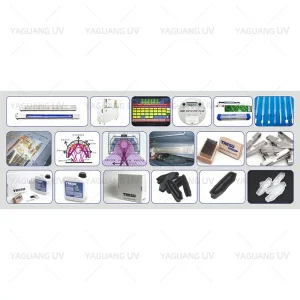
Request Technical ConsultationOur complete catalog of CE-certified UV drying systems and high-power LED retrofit modules.
 Yaguang Machinery